Sunday, September 29, 2013

Cultural Event - French Film


            On Wednesday, September 25, I attended a viewing of La Vie En Rose, starring Marion Cotillard. It is a French film about the life of French singer Edith Piaf. Cotillard actually won the Oscar for best actress in 2008 for her role as Piaf. The film is fun, sad, disturbing, and brilliant all at the same time.
            The whole movie was played in French with English subtitles, so it was difficult to keep up with for the most part. Fortunately, I enjoy watching foreign films, so I had no issues with the new language. In fact, I enjoy the French language. I like listening to what they say, and not look down at the subtitles all the time. That way, I can pick a few words at a time and go “Oh! I know what she just said!” It’s seriously a good feeling.
            I had never heard of Piaf before, but I have heard her music before. I like to watch films about people I’m not familiar with, but is familiar with many others. It’s like I’m hearing a secret and now I’m part of the club. I guess that’s the way with any film, but once I know about the person, I don’t get confused when I have to write a paper on the person, or something like that.
La Vie En Rose
            By the end of the film, I was very impressed by the whole thing: the story, the character, the actors, and just about everything else. It really made me think about French culture in the early 1900’s and how bad this woman had it as she was growing up. Poor woman died before she was 50 from liver cancer, but she looked like she had been deteriorating from some sort of skin disease since she was in her 30’s. I just felt sorry for the character.
            After viewing La Vie En Rose, it really got me thinking that I should see more French films. I will definitely have to watch more whenever the campus holds another one.

Cultural Event - French Conversation Table


            On Wednesday, September 25, I attended a French conversation table at the Blue Moon restaurant in Shepherdstown, WV. I heard about in my French 101 class, and I found it interesting because I enjoy the language and I want to learn more of it.
            Ever since I visited Quebec last year, I’ve always been intrigued by the French language. I took 3 years of Spanish in high school, but I really didn’t enjoy it. Since then, I wasn’t really into learning a new language. I decided to take a French class because I needed one more elective, and French was the only class I was remotely interested in that didn’t block any other courses.
            Since the semester started, I have enjoyed the class immensely. The teacher knows what she’s teaching, and she has fun doing it. You can really tell that she has a passion for the language, and she really wants us to immerse us in the culture. That’s why she hosts these conversation tables.
            On Wednesday, I met a lot of the students and Dr. Jarman at a table in the back. She arranged the tables so that I would sit next to her (because I’m her favorite student), and she just started talking. I caught a lot of words that she said and was able to figure out most of what she was saying. Other times she would have to translate into English for me and a few other students who were listening. I learned about how the French have very, very long meals, often ending with 7 different courses. And they have a different wine for every course. I find it very interesting.
            We all spoke in French for the first half hour, but after that, we ended up speaking in English. We were discussing how American culture is influencing the rest of the world, which isn’t necessarily a good thing, so I asked Dr. Jarman for her opinion on whether or not foreign culture influences the US. She said not at all, unfortunately, and went off on a tangent that lasted almost 20 minutes. It was pretty much a lecture and a half.
            In all, I had a very fun experience, and I learned so much that I wouldn’t have been able to in a regular class. I met a lot of new people and made some new friends. It’s definitely something I will do again very soon.

Friday, September 27, 2013

Senior Capstone - The Use of Humor in Violent Action Films

            While putting together the script for my film, I found a fascinating article written by Cynthia M. King that focuses on the need for humorous heroes and villains in violent action films. This is an extremely relative article because while drafting the script, I wanted to add humor to a lot of the lines. My problem with this is that I didn’t want to add so much that the film comes off s a spoof. One thing this article mentions is that in violent films such as Lethal Weapon or Die Hard, there’s a certain kind of humor being used.
"You have the right to remain unconscious"
            King discusses how Freud defined nontenditious humor and disparaging humor. Nontenditious is a form of joke work that has no hostile intentions. Disparaging humor, on the other hand, emphasizes “the victimization of one party by another” (King, p. 6). Its intention is to humiliate or harm the other party through hostility. Disparaging humor is evident in many action films as of late. One example of disparaging humor can be found in Lethal Weapon 3, when Officer Marty Riggs, played by Mel Gibson, finally catches a villain after a long and brutal armored-truck chase. When the truck crashes, the villain slams through the windshield, and landing on the fender. Riggs gets out, runs up to the body, raises the villain’s head and asks, “you ok?” before slamming it back down into unconsciousness. Riggs takes out a cigarette, lights it, and nonchalantly says, “You have the right to remain unconscious. Anything you have to say ain’t gonna be much.” The idea of the wisecracking character helps to emphasize the persona of the tough guy of the 1990’s.
Too much violence?
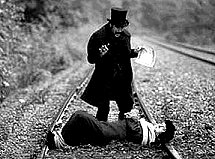
            I’ve always been a fan of action films, whether they are superhero action movies like Sam Raimi’s Spider-Man series, hard R-rated action films such as Saving Private Ryan or the Rambo series. But, I have always favored the comedy movies that have some sort of comedic relief to them. I think it all started when I was a kid, and was told by my grandmother that I wasn’t allowed to watch shows like The Three Stooges or Tom and Jerry at her house. Why? Because they were too violent for me. SERIOUSLY? If we were able to fast forward and show her what’s on TV now, Tom and Jerry would be the least of her worries. Last semester, I took a Sociology class that focused on the sociology of humor. One thing I learned in that class had to do with the physicality of one of my favorite forms of humor, slapstick. Slapstick is no longer slapstick when you introduce sympathy to the character. Sure, you feel bad when Moe pokes Curly in the eye, but that feeling goes away when he laughs and feels better almost instantly. How do you add sympathy to slapstick? You can either: A.) Have the victim cry, which is hardly seen or B.) Add blood. Once an injury is evident, slapstick becomes null and void. You have entered the realm of violence.
            For my film, I wanted to make the two heroes very different from each other, therefore adding to the cliché of “odd pair has to work together”. On the same coin, my villain is scary and intimidating, simply by staying calm 80% of his scenes. When he gets mad, he GETS MAD. The idea was to have him blow up at the most inopportune times. When I think about it, I believe that I did write in a line or two that expressed some sort of disparaging humor, but it didn’t happen often. I focused more on one-liners because, as I said, I didn’t want it coming off as a spoof. In conclusion, adding comedy to violent action films is very important to me because I feel like, without it, we don’t release some kind of catharsis, leading us to a more violent nature. Sure, I know the film is violent and shouldn’t be replicated, but no, I don’t feel like humor added to these films makes light of the situation or action. Humor in action films’ sole purpose is to humiliate the villain and show that justice will always prevail, or something like that.

Resource:

Thursday, September 26, 2013

Soup Headlines

"Fast and Easy Soup Recipes"
-Fast
-Easy
-Soup Recipes

"Warm Chicken Soup can Help Lower your Cholesterol"
-Warm
-Chicken Soup
-Cholesterol

"Soup Recipes for the Winter"
-Soup
-Recipes
-Winter

"6 Surprising Soup Ingredients"
-Ingredients
-####
-Surprising

"Seasonal Soup Recipes that are Quick and Easy"
-Seasonal
-Quick
-Easy

Friday, September 20, 2013

Senior Capstone: Male-Bonding in Buddy Films


            After just finishing the script for my film, I’ve really given a lot of thought into the relationship between the two main characters, Tom Alpha and Marty McCoy. The idea was to make a badass buddy cop movie about these two guys who are essentially Tango and Cash. I focused so much on the fact that they’re fighters, I forgot to write in a love interest. After giving it some major thought about the purpose of a love interest, I concluded that it was unnecessary, and furthermore, a waste of time.
The Damsel in Distress
            My interpretation of a woman in this kind of film is this: She can be a wife who worries too much about her man being out in the field (in this case, the character of Alpha), but I felt like that sort of character would have no change throughout the film. Another option would be to make her equal to our heroes, making her just as badass as them. This I liked, but I’ve noticed that this type of character shows up in sequels in this particular genre, and since I’m trying to emulate the genre, than that wouldn’t work either. Lastly, I could write in the basic female role of: girl meets boy, girl doesn’t like boy, boy woos girl to sleep with him (making her his only weakness), girl gets captured by villain, boy confronts villain, kills him, and wins the girl. This would be the only logical option, but frankly, I hate this formula. It is seen over and over in these types of movies, and it makes me sick. So, for this film I decided to change it up a bit.
            While putting together this script, I found an article about homoeroticism in Hollywood films. There’s a chapter about what it means to make a “buddy film” and what it means to be “masculine”. When reading, I found a quote made by Vincent Canby stating that it’s male filmmakers “shattering our egos, making us uncertain about our identities and persuading us to question something called ‘male-bonding’, which used to be known simply as friendship” (Lang, p. 181).  It made me wonder about the evolution of the genre from the 60’s all the way to now. This genre itself seems to have undergone a crisis of self-consciousness. I question whether the main heroes (mostly men) are in a love story with female interests or with each other. It really made me think about my two protagonists and (maybe) reinvent their personas.
Is this sociably appropriate?
            After much thought, I decided that these two characters are not directly homosexual, but they’re not completely heterosexual either. I tried to build in a lot of character development between the two; lots of male bonding. These guys are truly themselves when they’re just by themselves, and it’s very noticeable in some scenes. In fact, I purposefully wrote one scene where Alpha gets captured, and McCoy has to save him. I would have avoided a capture if possible, but I figured that, in order for the hero to confront the villain for the last time, he needs to for a reason, with that reason being 99% of the time, saving the damsel in distress. In this example, we can assume that McCoy sees Alpha as his damsel in distress. So, basically, I want my audience to decide whether these guys are secretly in love or not.

Resource:

Sunday, September 15, 2013

Senior Capstone: Defining Machismo


            When writing and putting together my story, I came across many patterns that become familiar once you’ve seen too many action films. One of which included to idea of “machismo”. This simply means “being macho”, which leads to “exaggerated masculinity”. The concept of machismo is simply preposterous because in real life, the average man cannot be defined as “macho” anymore. Usually the word is used to describe a man who’s being over-the-top with his manliness; a man cannot be macho if he does not shoot things or if he doesn’t have huge muscles. Just think of the action heroes of the 80’s: Bruce Willis, Sylvester Stallone, and Arnold Schwarzenegger.  These guys wouldn’t have been caught dead in a film with, say, Steve Martin or Matthew Broderick. Unless, of course, an unlikely team-up occurred: the buddy-cop subgenre. For this post, I want to focus on what “macho” really is, and why it’s important for its intended audience. I plan on saving the “buddy-politic” topic for next week.

Exaggerated form of masculinity
            When I see the word “masculine”, I think more than just “male”. It all depends on the situation (mowing the grass, playing football, shooting rifles), and it even goes as far as professions (police officer, boxer, military general); before political correctness, these stereotypes help true. Machismo is the most exaggerated form of masculinity you can get. To me, it’s so exaggerated, it’s no longer real; in fact, I see machismo as a way of making fun of very masculine men, without knowing it. In the 80’s action flick, most, if not all, main protagonist was a bulging mass of a man, just oozing machismo. One very good example of the macho hero is John Matrix, Arnold’s character from the film Commando. When the audience first sees Matrix, he is in the woods cutting down huge trees, carrying them OVER HIS SHOULDER, and splitting them into firewood, all the while gleaming with sweat and looking very “macho”. When you see the film, you can’t help but laugh at the preposterousness. There have been films where this form of machismo is parodied (Hot Shots Part Deaux) but in my opinion, these films make fun of themselves.
Arnold Schwarzenegger in Commando

            In Steven Cohan’s book Screening the Male: Exploring Masculinities in Hollywood Cinema, there is a chapter solely on the performance of masculinity. He emphasizes the fact that an action hero is not an action hero unless he clearly has bulging muscles (Cohan, p. 232). It’s the whole idea that the audience gets lost in the physicality of the character, therefore losing sight of his complexity of being an individual. Personally, I think that’s true in most cases, except for First Blood. Here, we have a character so lost in himself (he was tortured in Vietnam), any form of violence against him triggers his PTSD, and he becomes an uncontrollable killing machine. At the end of the film, Rambo breaks down and starts to cry on his commander’s shoulder (something completely un-macho). Cohan goes on to state that the reason as to why there is so much muscle in these films has to do with “sexual prowess” (Cohan, p. 233), and to that I say…DUH!
            How all of this is integrated into my story was the fact that I wanted to write a script that could focus on the sheer machismo of the Hollywood action film. I gave this a lot of thought, and I seriously considered giving my main characters bulging muscles, but I decided no. I agree with Cohan with the fact that a muscle-y hero detracts from the storyline. If I could take a stab by what is being implied here, I’d wager that the audience sees the hero as a big, dumb guy who can only solve his problems through violence and luck. I don’t want an audience to think that of the heroes I come up with. They need to be smart and witty and also have a knack at killing bad guys. If that means taking away the “machismo” aspect of the film, I’m sure it won’t detract from the entertainment at all.

Resource:

Tuesday, September 10, 2013

Wright Brothers' Flying Attempt Successful

Headline: 

Wright Brothers' Flying Attempt Successful

Byline: 

By Zachary Waters

Lead Paragraph:

Known brother inventors Wilbur and Orville Wright were successful in their first flying machine experiments. On December 17, 1903, the brothers' years of testing and guessing were finally put to the test at Kill Devil Hills, just four miles south of Kitty Hawk, N.C.

Explanation:

The first flight was made by Orville at 10:35 a.m. of 120 feet in 12 seconds.The next two flights went 175 feet and 200 feet, made by Wilbur and Orville respectively. Witnesses (there were 5) were amazed by what they were witnessing, but none were available for comment. Orville was able to comment on how one of the rudders was badly damaged at the end of the day, but "could be put in condition for flight again in about a day or two." And what did these brave men do at the end of their demonstration? They went into town to send a telegram to their father of their successful flights.

Friday, September 6, 2013

Senior Capstone: What Makes an Action Film a "BAD" Action Film?


            I like to consider myself a “movie connoisseur”, because I have seen a lot of movies in my life. It’s mostly what I do in my free time. Normally, I like to watch at least two movies a day, preferably ones that I’ve never seen before. Comedy, drama, horror, I don’t discriminate. BUT, there is one genre of movie that I can never get enough of. You might call it my “guilty pleasure” (and I’d be ok with that), but I LOVE to watch really bad action movies! Granted, I love really good action movies more, but there’s a soft spot in my heart for those action films that are just…so…terrible.
            You might be wondering what a “bad action movie” actually is. Let’s play a little game: Is Terminator a bad action movie? No, that’s a science fiction film mostly, but there is one factor that adds “action”, and that’s Mr. Arnold Schwarzenegger. Arnie has made lots and lots of bad action movies, including Commando, The Running Man, Red Heat, and most recently, The Last Stand (all of which I have seen, and I’m proud of it). As bad as Arnie can be, his films aren’t nearly as bad as a lot of his friends.
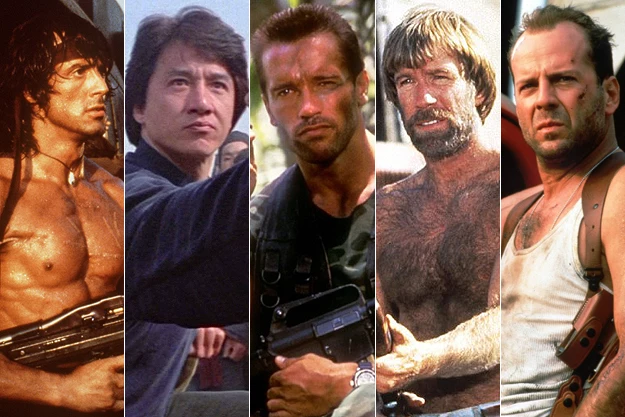
Action Stars of the 80's and 90's
            Can you think of any other action movies? How about Cobra? Or what about Demolition Man? Over The Top? Yes to all three! And what do these films have in common? You guessed it: They all star Sylvester Stallone. I have seen every Sly movie made, and I love most of them, but even I have to admit that a lot of them are just plain awful. Sly has made a name for himself doing the same shtick for years, and he still makes a killing off of them (just look at The Expendables films; they’re in the process of filming the third one NOW!). For more examples of some bad action films, just look up anything made by Jean-Claude Van Damme or Chuck Norris.
            Why am I talking so much about really bad action movies? Well, if you missed my last post, it’s because I’m making an action short film for my Capstone project! In order to help me focus on the task at hand, I’ve been doing a lot of research in the realm of action tropes and clichés. The goal is to integrate what I’ve learned so far into my story. The story, so far, is halfway finished. One bit of research that I found was an excerpt from James Welsh’s collection of essays on film genre. Welsh explains how there are 3 main points of an action film that identifies as just that, “an action movie”:
           
1.     The Main Protagonist
2.     The Director/Style
3.     The Producer

            The main character of such films is normally “a tough, potentially brutal, sometimes cynical, often laconic, preferably muscular, oversized hero” (Welsh, p.170). A lot of these action heroes are often forgettable and normally “expendable” to the audience, because they are almost always this same, muscular character described above (Unless the character is a lot more in depth, therefore ruling it out of the “bad action movie” genre). The only way we can remember such a character is by the action star portraying him: Arnie, Sly, Bruce Willis, Chuck Norris, etc.
            An action film is oftentimes recognizable by the style in which it was built. Styles are often based on the directors of the movie. The Lethal Weapon films would more than likely not done as well as they did if not for Richard Donner directing all four of them. Their style was so similar, and the formula was repeated so much, that it’s actually quite difficult to distinguish them as individual films. Other films include those made by John Woo (martial arts master) or Jerry Bruckheimer (action film director/producer guru of the 90’s).
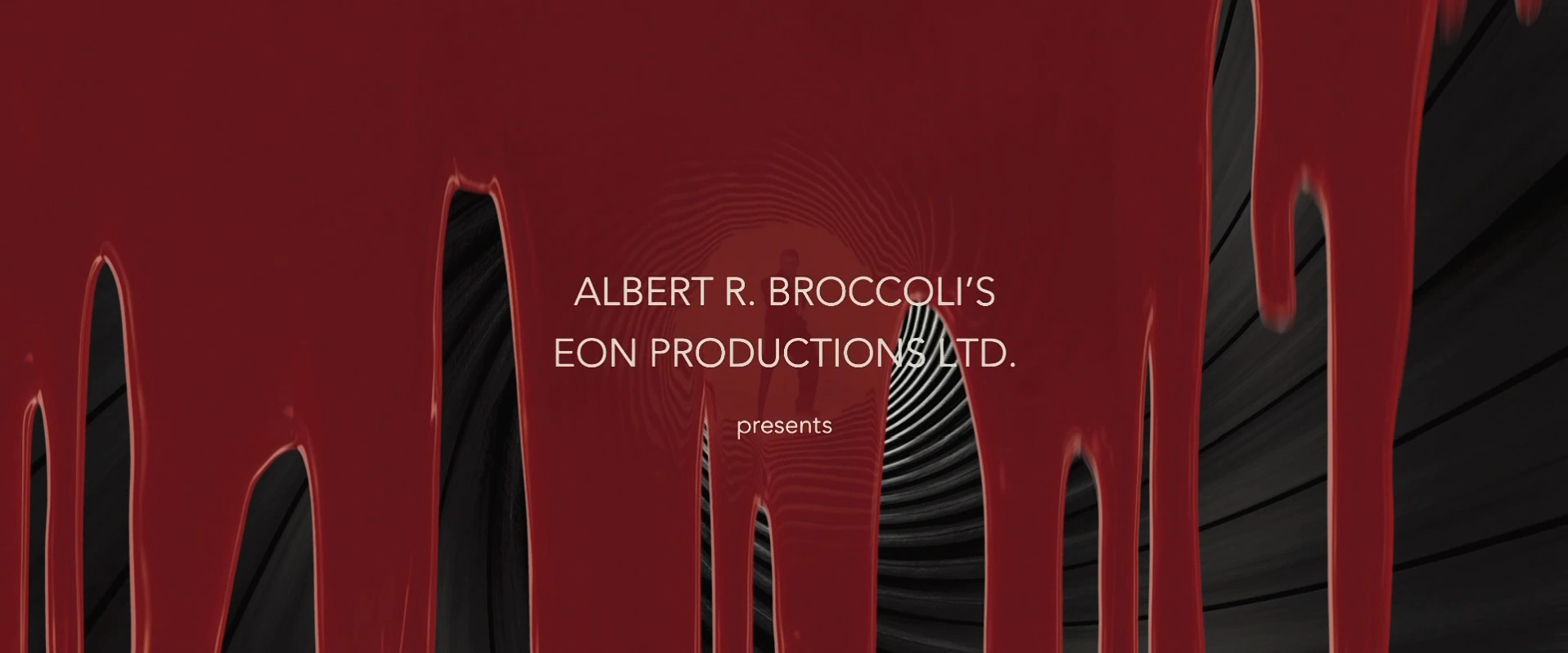
Albert R. "Cubby" Broccoli's legacy still lives on
            Lastly, an action film would not be able to gain its publicity without its producer. Some action franchises would be nowhere without their producers, case in point James Bond. Every single James Bond movie begins with some form of the name “Broccoli” at the beginning of the main credits, whether it’s “Cubby” Broccoli from 1962-1995 or his daughter Barbara from 1995-present. The Broccoli family has been in charge of the cinematic Bond franchise from the very beginning, and it looks like they haven’t slowed down yet.
            What I’ve been trying to get at this whole stinking post is the fact that an action movie is just an average action movie if it has the same stuff as any other action movie. What makes it BAD is when you put in an action star who’s “too old for this shit”, a director who has made his mark making a lot of action flicks, a producer willing to risk it all just to do it all over again, and finally, an audience group that doesn’t care how bad it is, they just want to see some gunfire, car chases, and explosions.

Resource:

Sunday, September 1, 2013

Statement of Intent


         For my Capstone project, I will be making a fictional film, as well as promoting it. Jason McKahan has agreed to be my Director. I plan to work for an advertising agency after I graduate, so hopefully by making my own movie and advertising it, I can gain a lot of experience.
         The film will be an 80’s action movie. For this project, I plan on integrating some common stereotypes/archetypes found in many action movies that were made in the late 80’s/early 90’s. I plan on researching some in order to give me a basic starting point on where to go with the story and characters. All I have for the storyline is the fact that it is going to be the standard “buddy cop” film, reminiscent of Tango & Cash and the Lethal Weapon films.
         I will be writing the screenplay on my own, but when the time comes to shoot and edit, I will most likely get some assistance from someone more experienced than myself. By stating this, I do not mean that someone will be doing editing job for me. What I mean is that if I get stuck using Photoshop (which is unlikely) or Final Cut (which is very likely), I will have someone on board my project that can guide me to a solution. I might even try to use iMovie, if I can produce the same product. In terms of building promotional material, I’ve got that covered to where minimal assistance is required.
         The idea of making an 80’s action film came to me after spending a good amount of time watching “bad” but very entertaining iconic films starring the likes of Sly Stallone, Chuck Norris, or Jean-Claude Van Damme. These types of films really are my guilty pleasures, and I just think coming up with one would really be a lot of fun. I think it’s going to be a blast.