Friday, September 28, 2012

Comparing Protagonist Introductions: Maus and Essex County

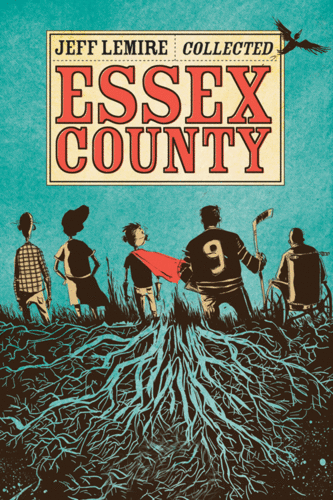
Essex County by Jeff Lemire

            So I finished Art Spiegelman’s Maus a few weeks ago. It’s a good read for anyone that enjoys a bit of history in his or her comics. After I finished it, I picked up Jeff Lemire’s Essex County. After reading the first book of County, it got me thinking about how main characters are introduced within these stories.
Maus by Art Spiegelman
            When the reader is first introduced to Vladek in Spiegelman’s Maus, it’s all through text. When you first start it, you’re introduced in Artie’s dialogue “I went to see my father in Rego Park. I hadn’t seen him in a long time – we weren’t close.” Immediately, I know how he feels about his father, Vladek (obviously). The thing is, I don’t think it’s quite necessary to use “we weren’t close” directly. As the reader, I understand that if the author states that he hasn’t seen his father in a long time, There’s something amiss: They live far away from each other; He never has time to visit; Their relationship isn’t strong; etc. As the reader continues the story, he/she gets the idea that the relationship is broken.
Artie's father, Vladek
            Anyway, in the first frame, we are introduced to Vladek, Artie’s father, and his very first dialogue says “Oi, Artie! You’re late. I was worried.” This shows that: 1) Through Vladek’s use of “Oi” and not “Hey”, he must be of European descent (North Americans hardly greet with “Oi”). 2) Vladek is somewhat impatient. The reader isn’t shown how late Artie really was, but since Artie never apologizes for his tardiness, he must not have been realistically all that late. And 3) Vladek does show compassion for his son. If Artie was just a few minutes late, we don’t see that as a big deal. Vladek, on the other hand, cares for his son just enough to think, “Artie was supposed to be here five minutes ago. I hope nothing bad happened to him!” Again, since nothing was explained about his tardiness, it must not have been a big deal. I believe that in this one frame, the reader is able to get a clear picture of who Vladek really is in just four sentences.
Lemire's character, Lester, can fly
            Spiegelman’s character is introduced in a very obvious way: the reader GETS that character right at the get-go. The same cannot be said about the main character in Jeff Lemire’s Essex County. Lester is shown at the beginning; there is a pan where the reader sees him staring at the top of the barn’s silo. As the frames focus on Lester himself, the reader can tell that he is just a young boy (maybe around young adolescence) wearing a cape and half mask. In just one frame, Lester somehow floats off the ground and flies through the field. Then just as quickly as it started, it ends with an outside voice yelling “Lester!” By this time, the reader has made it to page 13. All we know about Lester is that he is at a young age, he’s into superheroes (or he is one?) and that he daydreams about flying (or can he really fly?) All I can say is that I finished the first book, and I still have not completely understood Lester’s character yet.
            Basically, this exercise was to explain how these different books have different ways of introducing the main character. Spiegelman’s Maus is very straightforward with dialogue that helps the reader. Lemire’s Essex County differs by using no dialogue at all to show who Lester is. In fact, I would even argue to say that the reader’s perception of Lester is able to change depending on that reader BECAUSE he has no formal introduction. Something to think about…..          

Thursday, September 27, 2012

Characteristics of Popular Female VideoGame Characters, Part 2


            Last week, I started the topic of female characteristics that are often exaggerated in video games. We looked at a study that randomly picked games for the Nintendo 64 and Playstation, and sorted characters out based on the clothes they wore. It was concluded that the majority of female characters wore clothing that brought attention to their bodies, and that was it. This week, I will look into a smaller experiment, completed by Kelly Phillips (a Yahoo! columnist) in 2009.
Back of Need For Speed: Underground
            In Phillips’ experiment, she picked out three Nintendo Game-cube games at random from a stack of around forty. The ones picked were Mario Superstar Baseball, Need for Speed Underground and The Urbz: Sims in the city. After examining the front and back covers, it was clear how females were portrayed. In Need for Speed Underground, there was only a car on the front. On the back there was an average height woman wearing a white tank top and low rider pants. She had an above average sized chest, a somewhat small waist and tattoos on her upper left arm. It gives the impression that people driving the cars in the game were doing it to get the women (like a trophy at the end of a race). Even though she was not overly provocative, players of the game may assume that women love those who compete in street racing, so they tend to dress with more skin showing.
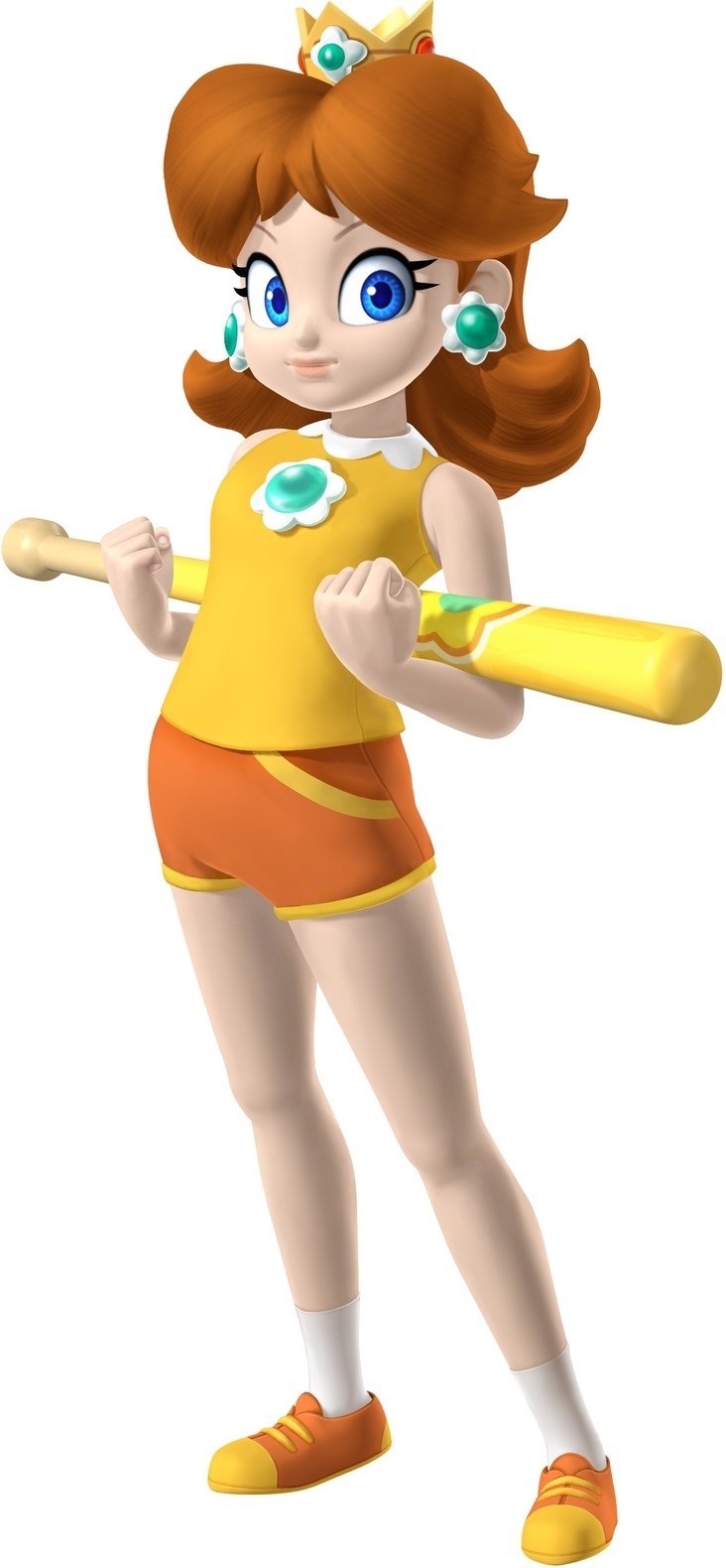
Daisy in Mario Superstar Baseball
            In Mario Superstar Baseball, the front cover only shows male characters (Bowser, Mario, Luigi, Wario, Donkey Kong) and an unidentifiable gendered dinosaur (Yoshi). All the characters are shown in a small column on the right of the back cover. This column includes the characters on the front plus two females, four other male characters and an “unidentifiable gender dinosaur” (Princess Peach, Daisy, Waluigi, Diddy Kong, Bowser Junior, and Birdo) [NOTE: This is where I disagree with Phillips, for she thinks that Birdo’s gender is unidentifiable. She wears a bow in her hair, she’s pink, and she winks and blows kisses a lot. To me, that says “female dinosaur”]. In total there were eight characters of male gender (two of which were nonhuman), two female characters (they both are wearing blue earrings), and “two” dinosaurs of unidentifiable gender. The female characters are only displayed as often as the dinosaurs, yet in the modern world dinosaurs are extinct and females make up half of the population. It can seem ironic that both of the female characters are wearing jewelry, as if they were going somewhere nice. However, they were only going to be playing baseball. This makes the players think that girls should always wear jewelry no matter what the occasion. They both have long hair, which is nicely put in a ponytail or a combed to their shoulders. This suggests women should always have their hair looking nice. These portrayals of characters hint at and teach gender stereotypes. Male superiority is shown by the abundance of male characters compared to female.
Some characters in The Urbz: Sims in the City
            In The Urbz: Sims in the City, there is an equal depiction of two males and two females on the front cover. On the back cover there seems to be a decent amount of females in four frames describing the game. This game has equal representation of both genders. There is a slight issue with the way females are clothed and their body structures. One of the females on the front has an above-average chest with a small waist, large hips and long thin legs. She is wearing a bare, midriff leather jacket, purple belly shirt and jeans that go down past her hipbones. The other female on the front had a very low cut purple jacket where cleavage is visible, and skinny legs with very tight sweatpants. This demonstrates that some games have become conscious that women should be shown equally. Yet, within these games, stereotypes about women's bodies are evident. Women should have a large chest, small waist and medium to large hips. They should be skinny and have a long neck and long legs. Though these games have made progress to show more women, they still show them stereotypically and do not take into account all women have different structures. This can teach male players to expect women to have "perfect" bodies, and female players of what they should look like.
            The Entertainment Software Association estimates that "fully half of all Americans age 6 or older play video games". This means that the majority of all Americans who are six years of age or older have been learning from video games. They learn that males, being more prevalent in the games, are superior to females. They are taught that women should look and dress certain ways. Also, women are seen as submissive and/or as sex icons and hardly ever the heroes. Even when women are shown as main characters or heroes, they are dressed in provocative ways. In 1992, Eugene Provenzo Jr. suggested, "Like television, video games are a type of medium providing information that both entertains and educates." It seems he is indeed correct.
            It is obvious that video games play a major role in the lives of children, young adults and even some older people. Anyone can learn so much from these games. Yet, are the games teaching correct and moral concepts? This new industry has impacted the lives of people all across America. Have we, as Americans, really gotten past inequality among genders? The video game industry suggests otherwise, through stereotyping and male superiority, that we still make assumptions based on gender. So, next time you pick up that controller, you ask yourself, "What am I really learning here?"

Monday, September 24, 2012

Characteristics of Popular Female VideoGame Characters, Part 1

-->
Yuri Sakazaki
              Last week, I emphasized on one of the most iconic female characters in the realm of videogames: Lara Croft. This week, I intend to take it a step further by analyzing characteristics of other famous female characters within popular videogames. As stated in previous blogs concerning this topic, women have not been portrayed as equally to men in past games. In 1998, researcher Tracy L. Dietz examined thirty-three games on the Nintendo and Sega Genesis game consoles. Thirty-one percent of the games did not have a female character. When there was a female character, she was shown in a submissive position. Merely 15 percent of the female characters attained hero statuses; the others were princesses or wise older women. Throughout this blog, I will give examples of female characters that have attributed to this gender role stereotype.
              In 2002, Berrin Beasley and Tracy Collins Standley did a study on clothing as an indicator of gender role stereotyping in video games. They randomly picked games from Nintendo 64 and Sony Playstation. All of the characters (human, animal or object in a video game which displayed human-like characteristics) were coded based on their gender and their clothing. Clothing was further divided by sleeve length, neckline, lower body attire (which was later removed because the findings were not significant), and cleavage. From the forty-seven games, five hundred ninety-seven characters were coded.
Claire Redfield fights zombies with a very low neckline.
            The results were intriguing. Of all the characters analyzed, 427 were men, 82 were women, and 88 were of an indeterminable gender. This means that most of the characters portrayed in video games are male. Around fifty percent of the world is female, yet only a fourth of the video games included females (Beasley and Standley, 289). Under-representation of females shows how males are privileged in games. It was also strange that there were more aliens or creatures represented than females, which can lead one to believe females are less important than non-existent creatures.
Even a cute, cartoon character like Amy can be sexualized.
            In sleeve length, nearly half of the females were shown without sleeves; most were wearing halter and tank tops or bathing suits. This proved that women are shown with fewer clothes than men in video games. Of the 28 characters with a low neckline, 24 were female. Of the 71 female characters with visible cleavage, 29 (41%) were considered voluptuous (having large or overly large breasts). Furthermore, 31 percent of the characters with voluptuous breasts were in games rated E for everyone. This means that little kids play games with suggestive characters. Thus, the majority of the female characters are dressed in such a way as to bring attention to their bodies (Beasley and Standley 269). Bringing attention to the bodies of females shows the stereotypes of what women "should be."
            Next week, I plan to expand on studies of this nature by using examples of specific videogames.
           

Thursday, September 20, 2012

Response to "Rememberance of Computer Disks Past


            Well, there’s not much to say about this article: It’s informative, very historical, and mostly boring. I found it uninteresting mostly because it’s difficult for me to follow all of the computer jargon. Although, that doesn’t mean that I did not find it informative (double negatives; yeesh!). Basically, I learned something new after reading this article written by Michael S. Malone. The history of how the first supercomputer was first thought up, plus the quick evolution of computer memory caught my attention the most throughout this article.
            It’s cool to think about how, in 60 years, our species has been able to improve computer hardware to where we are today. I will say that I do remember the floppy disc, even though I try to forget it. I was required to have one for two years in middle school, then one year they required “Sandisk sticks.” And that’s what the teachers called them throughout high school. Not even exaggerating. Presently, I work at a local Staples, and we do sell a variety of “memory sticks”, but people still are oblivious to what this technology is capable of. You wouldn’t believe how many times I get this one: “What’s a GB?” or this one: “How does it work?” There are times when I miss the old floppy disc, but they don’t last long.
            I’m able to relate my life experience to what I read in this article because I can picture exactly how all of these events were able to lead to the technology we use today. Without all of these men’s decisions, I probably wouldn’t be typing this blog as easily as I am now. The author was very knowledgeable of this topic (obviously, because he writes for the WSJ), so I know that I can trust that this all happened. In all, as I said, I found it most informative, but not so much interesting. Regardless, I got a lot out of it, which is more important.

Tuesday, September 18, 2012

Lara Croft: First of Her Kind


            When videogames first came out, they were geared towards young men and not girls. By the 1990’s, women were beginning to show interests to videogames, but there was something they wanted that these games were all missing: a female heroine. In the late 80s and early 90s, both Nintendo and Sega wanted to have nothing to do with changing their formula, knowing that if they were to push their games on women, their current players (boys and young men) would fall out of their market. Sony, who addressed all youth groups, broke the formula and created a game that featured a woman as the lead protagonist. This game had a sort of Indiana Jones feel to it, but also having enough originality to stand on its own. It was called Tomb Raider, and the main character was none other than Lara Croft.
            Helen W.Kennedy has studied characters in media and computer games for a time now. She has even published some volumes of her game studies titled The International Journal of Computer Game Research. In one of her chapters, she focuses on Lara Croft, posing the question: Is Lara a feminist icon or just a “Cyberbimbo”? There is no doubt that Tomb Raider marked a significant departure from the typical role of women within popular computer games, but over the years, she has been labeled as “eye candy” for male fans of the series. It can be said, though, that her success was both because of her adventurous ways within the game and the use of her female body.
Typical female heroine?
            The obvious connection between Tomb Raider and film narrative conventions and the way in which the game deploys themes and tropes from other popular cultural forms means that a feminist critique at the level of the politics of representation is somewhat inevitable. One such possible feminist approach might be to welcome the appearance of active female heroines within traditionally male or masculine genres. Lara Croft is by no means the first gun-toting action heroine and the iconography of her representation conforms to conventions deployed from Annie Get Your Gun onwards, but also has forerunners in comic book heroines such as Tank Girl. If, for example, we were to compare her to the representations within the female buddy-movie Thelma and Louise we can find many key commonalities. Tomb Raider also reworks a male-dominated genre and features a female central character: Lara totes a gun as she navigates a hostile landscape fraught with danger. Consider also the ending of Thelma and Louise – they die within the story yet the white screen and the snapshots of them during the credits offer other possible, more positive, endings; with Lara this process becomes even more elaborated as she is resolutely immortal – with each death there is the possibility to replay the level over and over until it comes out right. The popular media and feminist response to Thelma & Louise was also similarly polarized around the issue of their representation – did the fact that they wielded guns guarantee or undermine the films status as feminist? The juxtaposition of physical prowess and sexuality continues to produce a great deal of ambivalence amongst feminist and non-feminist commentators.
Angelina Jolie as Lara Croft in 1997's Tomb Raider
            There is another feminist film studies approach that is much less inclined to celebrate the presence of masculinized female bodies. Psychoanalytically informed approaches which have developed from the insights offered by Laura Mulvey's landmark essay (1975) on the function of women within film narrative have a very different take on the tropes of this type of image. Two key insights, which appear relevant to Lara, are Mulvey's argument that the female body operates as an eroticized object of the male gaze and the fetishistic and scopophilic pleasures that this provides for the male viewer. The second argument was that "active" or "strong" female characters signify a potential threat to the masculine order. This is a more complex argument, dependent as it is on a pyschoanalytic reading of unconscious processes. Within this narrative the female body is a castrated body and as such it represents the threat of castration itself. This threat, it is argued, is disavowed or rendered safe by the phallicization of the female body. It could be argued that Lara's femininity, and thus her castratedness, are disavowed through the heavy layering of fetishistic signifiers such as her glasses, her guns, the holster/garter belts, her long swinging hair.
            In the end, it is impossible to securely locate Lara within existing feminist frameworks, nor is it entirely possible to just dismiss her significance entirely. Kennedy demonstrates the range of potential subversive readings, but there exists no real "extra-textual" evidence to back this up – hence the focus on the text itself, which is on its own inadequacy to explore the range of pleasures available from playing as Lara – we can only conjecture. The girl gaming community, which communicates via the internet, has its own highly critical discourse about the imagery and content within computer games. They not only complain about the degree of sexist portrayals of women but also bemoan the stupidity of many female games characters and lack of strong female leaders in role playing games.

Gender Roles in Videogames

Two boys enjoying the arcade

            The topic that I picked was on male and female portrayals within the videogame world. In order to do that, though, we have to first point out the audience of videogames. Big Download had a story in 2008 that focused on gender roles in videogames, so I decided to use it as a source. One point I would like to discuss is the assumption that “girls don’t play videogames.” If you believe that videogames are part of a “Men Only” club, I suggest that you grow up and move out of your mom’s basement because women (both young and old) have quickly learned that games are fun, and a lot of women have considered themselves gamers.
            Certainly, before games made it home, arcades were the only places that people could play games at in the 1980s. It’s not like women weren’t welcome in these arcades, but they were dark, smoky, and very loud, so girls just were not all that attracted to these sorts of places. By the time the game system made it to homes, girls who may be interested in the game would automatically be told to “go away” by a brother or another boy in the house.
Mario saves Peach
Zelda is held captive
            The rise in media also helped to perpetuate this stereotype as well, since advertisements for specific games showed women wearing nothing but fantasy clothing and violence. They were geared 100% to males in order to “bolster sales” solely on the model, not so much the game. I also believe that, sadly, the contents of a game followed suit. Just think about a narrative that has been used all too often in media: Man is content with woman. Antagonist takes woman. Man must save woman since she can’t fight back. The End. These games are telling the audience that the woman is simply an object of desire. A prize that must be possessed. A thing.
Tomb Raider: Enter the female hero
            Even female gamers never had an opportunity to play as a female protagonist until recently (10-15 years ago). Women in videogames were always “the girlfriend”, never wife or “equal”. Women games designers didn’t exist, therefore men designers only made stories about male heroes. Is this because they couldn’t relate to females? Perhaps, but I also think that there were some sorts of chauvinistic views that came into play. There were games, however, like Golden Axe and Streets of Rage that showed that women could hold their own within a game. Although, these women were just alternative characters that were no different from their male counterparts; but it can be said that this is an example of gender equality within a videogame. It wasn’t until the introduction of the Tomb Raider games that audiences were able to play as an actual female protagonist, Lara Croft.
            In my next blog, I will turn my attention to one of gaming’s most influential female hero, Ms. Lara Croft. Even though there is still a predominance of women in games as sex objects in modern games, I believe that we have very much improved and advanced in gender roles since the 80’s. More women are not only playing the games, but developing them as well. Both groups are vocally expressing their opinions in a way that has showed some heavy amounts of change in the way gender roles are perceived by both sexes. There are still some issues that have yet been addressed within this realm, so it’s a good thing I decided to pick this topic and high time I continue this research!

Saturday, September 15, 2012

Concerning People Without Social Media


            Isn’t it sad when our society decides that social media is a good thing? In my opinion, HELL NO! But, there are some people out there that actually don’t have a Facebook or Twitter, two of the most popular social media sites out there, because “they just don’t want one.” In fact, a little more than a third of the U.S. population does not have either of these accounts. Shocking!
            According to a recent (2011) independent study conducted by Marketing, E-Commerce and Web Development expert Jamie Grove, 34.5% of the United States population do not have a Facebook or Twitter account. The survey asked if the individual signed into websites using a Facebook or Twitter account, and then it asked why. Responses included: Yes – Because it’s easy; No – I don’t understand how it works; Yes – But I hate it; No – I’m scared of scams. Results varied between age, but there was a pattern that showed that 41.7% of people without one of these accounts were age 65+. This would make sense since old people don’t know how to work computers. I may sound like I’m holding stereotypes, but I want to be perfectly clear when I say IT’S TRUE! A lot of old people have succumbed to owning some sort of computer, but maybe half of those owners don’t have email accounts. I can promise you that the majority of those computer owners don’t have a Facebook or Twitter because they simply don’t want to learn how to use it. I hear from old people all the time that younger people should not spend so much time “staring at screens”, but I believe that the people of our generation have learned a lot from our “screens”. Maybe that’s just me.
            Now to my opinion of sites such as Facebook and Twitter: I am a firm believer that without these social media sites, the only contact human beings would have with each other would be telephone. You’re probably saying to yourself: But Zaq, We’ve been through this before, so what’s the big deal? The big deal is this: How are we supposed to advance as a technological race if we don’t advance technologically!? Without these social sites, we would not have the technology we use today. These sites advertise jobs, they help you shop online, they keep you in “the loop” with the people around you, not to mention people that you’ve never even met before (dating websites?). Without Facebook, we would never stay as connected with people as we do today, and if you’re a member of the 34.5%, just know that I’m more of a human being than you are. LOL KTHNXBYE =D

Wednesday, September 12, 2012

Use of Frame Transitions Within "Maus"


             Imagine being in a room all by yourself. There’s no one with you, save a few pieces of furniture (chairs, a sofa, a table or two, etc.). Now, imagine leaving that room; walking towards the nearest door, opening it, and leaving the previous room in order to enter the next room. Now that you’re in the new room, think about what happened to the room you were just in. Is it still there? Did it only exist to entertain your imagination, or was it real after all? Hopefully, it’s the latter since rooms don’t magically disappear, but it’s still an interesting fantasy.
            Scott McCloud uses this example to introduce the topic of “closure” in comic books. Closure is the term that is used when we “connect the dots” in our lives. It’s kind of like chunking, but instead of using assumptions, our brains decide to use perspective. This idea of closure is used quite often in comic books. Think about it: What’s the point of using still, visual frames, and then putting a space in between each space? It’s so you can “connect the dots” or “close the hole” or whatever best fits you. When a frame changes, it is called a transition. These transitions are very important and must be discussed in greater detail.
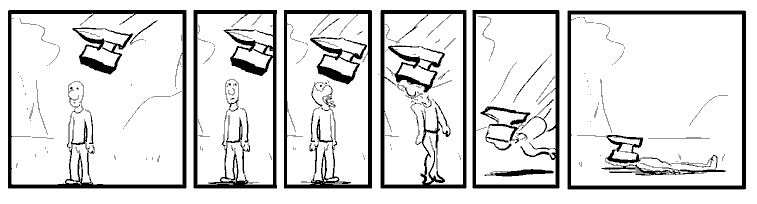
You are making this anvil fall on this man's face. How do you live with yourself?
            According to McCloud, there are six different types of these transitions: moment-to-moment, action-to-action, subject-to-subject, scene-to-scene, aspect-to-aspect, and non-sequitur. Moment-to-moment takes place when there is hardly any closure at all (Example: blinking eye slowly). Action-to-action refers to when a frame features a “single subject in a distinct action progression”(McCloud, 70) (Example: boxer in pre-punch; boxer in post-punch). Subject-to-subject means change in a scene, but staying within that same scene or idea (Example: runner finishes race; timer is stopped). Scene-to-scene often requires deductive reasoning on the reader’s part so that this transition may transport said reader across “significant distances of time and space” (McCloud, 71) (Example: frame from 2 years before; frame from 2 years after). Aspect-to-aspect bypasses time and sets a “wandering eye” (McCloud, 72) on specific places, ideas, or moods (Example: snowing outside house; Christmas tree inside). Lastly is a non-sequitur transition, which makes no logical relationship between two frames (man with sword; plastic fork). Now that I have explained each transition, I feel I must adapt it to something I’ve read. Recently, I finished reading Art Spiegelman’s Maus, so I believe that would be a good place to start.
Oftentimes, Maus will include many flashbacks to help the story flow between times
            Spiegelman is popular for using a wide variety of different transitions within his works, with Maus using examples from action-to-action, subject-to-subject, and scene-to-scene. I believe that the story is dominated mostly by scene-to-scene transitions, but they are used fluidly between pages. Specifically, he uses them to identify present-time and flashbacks since his father is the one telling the story to him. Some specific pages include at the top of page 47, the middle of page 63, top of page 86, between pages 135 and 136, and so on. This is used quite frequently to try and time in the past and present; make it feel like one, fluid story.
Vladek is upset at Artie for spilling cigarette ashes on the floor
            The second transition that Spiegelman uses often is an action-to-action transition. A lot of comic books (especially hero stories) use this one a lot because it’s easy for the reader to visualize, plus it’s less for the artist to explain. It’s used frequently throughout the book, including page 48, when Vladek shoots the man in one frame, and in the next he falls, page 52 when old Vladek scolds Artie for getting cigarette ashes on his floor, and page 127 when Artie and old Vladek are in the bank viewing the contents of the safe deposit box.
Vladek sees the Swastika for the first time
            The last transition he uses that I will discuss is subject-to-subject. It’s quite apparent on page 32 when Vladek and Anja are travelling by train to a sanitarium. In one frame, all of the little mice Jews are looking out the window, terrified at what they see, but the audience cannot “turn around” until the next frame. In the next frame, it shows that the mice are actually staring at a large Nazi flag in the middle of the town. The scene does not change, just the subjects within the scene.
            The art of transition with comics is quite an ingenious idea. The author lets the reader do half the work for him/her. It’s even really cool once you realize how important the spaces between frames (called “gutters”) really are; they’re more than just empty space. Also, after reading Maus, I’ve come to a better understanding to the way comics are written and how much of an art they really turn out to be.

Sunday, September 9, 2012

A Response to "Worker Abuse and Underage Employment at Six More Samsung Factories"


           Today, I read an article that was supposed to shock me but didn’t. The title is called Report: Worker Abuse and Underage Employment at Six More Samsung Factories. Sounds absolutely terrible, doesn’t it? It’s awful to hear about when workers are being abused in factories, but to be quite honest with you, I believe that it’s part of nature, unfortunately.


            I’m probably going to Hell for even thinking this, but it’s true: In order to move forward, sacrifices need to be made. Throughout history, workers in factories have almost always had it bad, and I agree that changes have to be made in order to better the human condition. What Samsung is doing to their hard-working employees is wrong and selfish, but nothing is going to happen; no changes will occur because, if it does, our technology performance will drop tremendously. And that’s something we cannot have.


            I believe that this is a topic that people absolutely hate hearing about, but there’s a silent agreement that it’s necessary. People even die in these factories, and the average American consumer just pretends that it didn’t happen. We benefit from these poor people’s misfortunes. They employ underage workers, force employees to work an average of 150 hours overtime PER MONTH, and even abuse them physically and verbally. And you’re probably thinking: “Gee, I really wish they would improve their labor conditions, but I enjoy my smart phone way too much to make them stop”. At least, that’s what I’m thinking.


            My point is this: I’m not going to stop using my smart phone just because some underpaid Chinese twelve-year-old made it. If I did that, then I would also have to do some research on who made everything I’ve ever owned. Chances are I own a shirt or two that was made in a sweatshop or something of that nature. I understand what’s happening is bad, but I won’t lift a hand to stop it because then I (the consumer) will suffer.   


Monday, September 3, 2012

Game Design Topic: An Introduction


My topic that I plan to write about throughout this semester involving games in general involves gender roles within video games. It strikes me as interesting because it’s such a broad topic that can be viewed in different ways by many people. Some questions that I look into include: Why do people play as different genders in a game? (E.g.: Why do some males play as females in MMOs?) Why are men and women often exaggeratedly stereotyped in games? What’s the big deal with the sexualized nature of video games today, and where will it be in 10 years? These are questions that I myself have been asking as of late, and I plan on answering them in the near future for this class.
Persona 3 allows the player to rethink who his/her character really is.
            One of the first references that I found was written by a female video game journalist named Leigh Alexander. She is the news director for Gamasutra, author of the Sexy Videogameland blog, and freelances reviews and criticism to a variety of outlets. Her article is titled “What I Discovered From Gaming Like a Girl”, and in the article, she discusses her interactions as a female character within the realm of Persona 3 portable (an adaption for the PlayStation Portable). She states how she originally played the game as a male, and decided to play as a female the second time around; she then goes on to explain how the game was an incredibly different experience just because she was a girl. For example, there were many dating options if one was to play as a male character, but once one was to switch genders, there were far less options. I personally haven’t played Persona 3, so I sort of got lost throughout this whole article, but I understand the whole “less options” thing once you change genders. The same situation is in the Mass Effect games, where male Shepard has many characters to choose from in order to start a romantic relationship (including 2 homosexual advances). The female Shepard is different, where she can only hook up with (maybe) 3 men and 1 woman, if I was to “guess-timate”. The article ends with Alexander claiming that playing as a female character made her rethink who she was as a character, which strayed her away from the team effort that the game is all about.
Female Shepard is just as powerful as male Shepard, but she has far less options.
            The second article impressed me more than the last one, mostly because it was a response to it. It’s a blog posted by username: Ted. Ted is a big fan of Leigh Alexander because she “is probably one of the more controversial video game journalists………she refuses to shelf her gender while writing about video games.” He goes on to explain how, in a male-dominated gamer culture, it’s difficult to get past the stereotypes and expectations as a gamer (males play as male characters, and females play as female characters). However, Ted shares with his audience that, despite our one-minded culture, he is not ashamed to play as a female in open-world games. His character in WOW is a female dwarf that is a warrior, engineer, and master chef. He goes on to explain that female characters are often more complex than the “bone-headed” male protagonist. Females allow the gamer to expand his persona. In literature, the woman is a far more complex creature than her male counter-part. She can be a virginal maiden or a femme fatal. She can heal or she can destroy. Females in the fantasy genre is often portrayed as a character who is capable of oftentimes anything. According to Ted, “the male persona in fantasy is generally hyper-masculine, the Campbell hero archetype inflated by a hundred-fold and infused with the dreams and desires of the alpha male in a fraternity.” They’re the all-muscular, rash warriors. Definitely not as complex.
Team Fortress 2's Heavy is the typical stereotype for the video game male.
            By choosing this topic, I hope to explore the world of gaming through the use of render role to help clarify the similarities and differences. By doing this, I plan to discuss and clear up any misdirection my audience has about the “typical” male or female character. I hope to show that there’s nothing wrong with playing as a different gender, or possibly being attracted to a game character (if you’re into that type of thing, that is), and also how video game designers are able t get a story or point across just by the looks of their characters. It’s quite a broad topic, as noted above, but I hope to better educate you in it.     

Sunday, September 2, 2012

McCloud's Concepts: As Applied To Art Siegelman's "Maus"


            After finishing the reading from Scott McCloud’s Understanding Comics, I realized that I’ve been looking at comics and graphic novels the wrong way. Now, I’ve come to understand that there’s more to it than the “entertainment factor”. This guy is a complete and utter genius. Period. He has taken the concept of the simple “comic”, and has blown it up into something that I didn’t expect at all: a true “invisible art”. Also, the few concepts he discusses in the first fifty pages help to open the viewer’s eyes when looking at a comic book. When reading a graphic novel such as Art Spiegelman’s Maus, these concepts come to life and occupy these pages just as McCloud describes.
            Maus is the tail (hehe) of Vladek Spiegelman, a Jewish survivor of Hitler’s Europe, seen through comic form. It’s a biography of the author’s father and how they tended a broken relationship. By hearing his father’s story, Art is able to depict a horrifying and interesting view of Nazi occupied Europe. He decides to write his father’s story as a comic book in order to help the audience understand what exactly his father went through in his lifetime in Europe. The most interesting out of it all was the use of animals as people.
Mouse-like Holocaust victim
            By using animals, Spiegelman is showing how exactly everyone was or acted throughout the story. It all starts with a mouse: normal Jews are depicted as mice in the story to show that back then they were seen as vermin. Just think about the Holocaust and how they populated camps, were slaughtered “like rats”, and some even resembled mice. Mice can also be depicted as cute and harmless, so Spiegelman uses that aspect to show that, after the war, everyone looks normal and cute and non-threatening. Cops are also depicted as pigs, and Nazis are obviously cats.
            Spiegelman also uses cartoons for another purpose. This purpose is emphasized in McCloud’s book because writers use it all the time: self-perception. When one sees a photograph of one man, it is understood that there is one man, and that he cannot be anyone else. The less realistic a picture becomes, the more that can be perceived by the viewer. In comics, they can be used all the time to depict more than just what is seen. By using cartoon mice, Spiegelman shows that his characters are not just him and his father, but whoever else that can be seen by the viewer. If I knew someone who suffered in a concentration camp, I may see that individual within these pages. It all depends on the audience.
            These texts are good reads, and I recommend them to anyone who is interested in the realm of comics and comic theory.    

Samsung vs. Apple: Controversy Behind the Verdict


            I, for one, had no idea that there was any court case between the world’s biggest tech companies Apple and Samsung. When I first heard about it, my initial response was “Oh, there must be an issue with one of Samsung’s phones. They’re obviously developing a phone that mirrors the iPhone. They’re gonna lose.” I guessed absolutely correctly, but what I was unaware of were the ramifications this could infringe on the world of technology.
            I can’t help but think that maybe this was a bad idea for Apple. I mean, it’s a definite loss for Samsung and Apple makes over one million dollars. How is this a bad idea, you ask? Think of it this way: Apple is a superior technological machine, right? And it has been rapidly advancing in this field as a “super-power”, right? If that’s the case, how are the rest of these tech companies supposed to sell their products if everything they accomplish is considered, essentially, “plagiarism”?
            I skimmed over the CNet article concerning this case, and I found something that caught my eye that has made me a bit skeptical about Apple. According to the article, Apple has banned 8 out of 28 Samsung products that “infringe” some specific patents that Apple holds. A few among them include Galaxy @ II 4G, Galaxy S II, Droid Charge, and Galaxy S II Epic 4G (to name a few, as noted). Now, to quote the article, Apple claims that this list “only address[es] a portion of the immediate, ongoing irreparable harm that Apple is suffering." What “irreparable harm” are they talking about!? I know, for a fact, that Apple has not been suffering from Samsung’s latest batch of devices. Market Watch has Apple ahead of Samsung in sales for the last 6 months! How is that “suffering”?
            Lastly, I would like to add that I read the EnGadget editorials about the verdict. I found the one written by Darren Murph most interesting. He starts off by making it clear that there was no way imaginable that Apple was going to lose this case. It’s clearly obvious, as I noted earlier. It’s visually clear that they are not the exact same, but there are similarities that would confuse to consumer to believe that they were. Murph emphasizes that, even though they are similar, the consumer is “supposedly” smart enough to understand that they are not the same phone (or tablet). He claims how “the notion that consumers could have been willfully deceived that an Android-based Samsung phone was an iPhone is pathetic”, and he’s right! We’re becoming a society that wants to pride itself based on the technology we use. Parents are letting their children get iPhones at an earlier age every year; Baby Boomers are taking classes to educate them more about computers; people will go to stores like Best Buy or Staples, and learn every little detail about a specific product just to understand what makes it tick. Basically what I’m trying to say is this: People know their shit.
            What struck me as the most interesting of Murph’s editorial was the last paragraph. He says: “In the end, consumers will lose. Companies high and low are scrapping potentially amazing product ideas right now for fear of legal retaliation.” Does this mean that if HTC develops a smartphone that has pinch-zoom, they have to scrap it? Yes it does, because that “action” belongs to Apple; it’s patented. And it’s not just Apple, but any company that holds a patent on “[insert obscure shape here]”. It’s sad because we (the consumers) are paying the price for these companies lack of creativity. I say that for the sake of technological advancement, let these companies steal the little things from these more superior companies. If they don’t act fast, I predict Apple holding a monopoly on cellphones and (if not already) tablets.