Imagine being in a room all by yourself. There’s no one with
you, save a few pieces of furniture (chairs, a sofa, a table or two, etc.).
Now, imagine leaving that room; walking towards the nearest door, opening it,
and leaving the previous room in order to enter the next room. Now that you’re
in the new room, think about what happened to the room you were just in. Is it
still there? Did it only exist to entertain your imagination, or was it real
after all? Hopefully, it’s the latter since rooms don’t magically disappear,
but it’s still an interesting fantasy.
Scott
McCloud uses this example to introduce the topic of “closure” in comic books.
Closure is the term that is used when we “connect the dots” in our lives. It’s
kind of like chunking, but instead of using assumptions, our brains decide to
use perspective. This idea of closure is used quite often in comic books. Think
about it: What’s the point of using still, visual frames, and then putting a
space in between each space? It’s so you can “connect the dots” or “close the
hole” or whatever best fits you. When a frame changes, it is called a
transition. These transitions are very important and must be discussed in
greater detail.
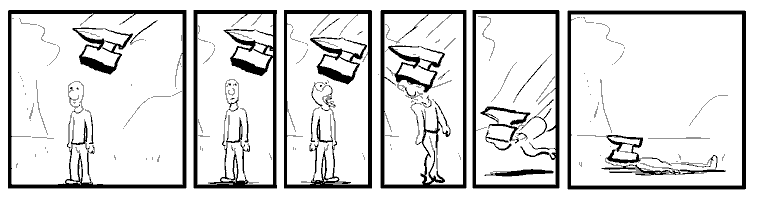 |
| You are making this anvil fall on this man's face. How do you live with yourself? |
According
to McCloud, there are six different types of these transitions: moment-to-moment,
action-to-action, subject-to-subject, scene-to-scene, aspect-to-aspect, and
non-sequitur. Moment-to-moment takes place when there is hardly any closure at
all (Example: blinking eye slowly). Action-to-action refers to when a frame
features a “single subject in a distinct action progression”(McCloud, 70) (Example:
boxer in pre-punch; boxer in post-punch). Subject-to-subject means change in a
scene, but staying within that same scene or idea (Example: runner finishes
race; timer is stopped). Scene-to-scene often requires deductive reasoning on
the reader’s part so that this transition may transport said reader across
“significant distances of time and space” (McCloud, 71) (Example: frame from 2
years before; frame from 2 years after). Aspect-to-aspect bypasses time and
sets a “wandering eye” (McCloud, 72) on specific places, ideas, or moods
(Example: snowing outside house; Christmas tree inside). Lastly is a
non-sequitur transition, which makes no logical relationship between two frames
(man with sword; plastic fork). Now that I have explained each transition, I feel
I must adapt it to something I’ve read. Recently, I finished reading Art Spiegelman’s
Maus, so I believe that would be a
good place to start.
 |
| Oftentimes, Maus will include many flashbacks to help the story flow between times |
Spiegelman
is popular for using a wide variety of different transitions within his works,
with Maus using examples from
action-to-action, subject-to-subject, and scene-to-scene. I believe that the
story is dominated mostly by scene-to-scene transitions, but they are used
fluidly between pages. Specifically, he uses them to identify present-time and
flashbacks since his father is the one telling the story to him. Some specific
pages include at the top of page 47, the middle of page 63, top of page 86,
between pages 135 and 136, and so on. This is used quite frequently to try and
time in the past and present; make it feel like one, fluid story.
 |
| Vladek is upset at Artie for spilling cigarette ashes on the floor |
The second
transition that Spiegelman uses often is an action-to-action transition. A lot
of comic books (especially hero stories) use this one a lot because it’s easy
for the reader to visualize, plus it’s less for the artist to explain. It’s
used frequently throughout the book, including page 48, when Vladek shoots the
man in one frame, and in the next he falls, page 52 when old Vladek scolds
Artie for getting cigarette ashes on his floor, and page 127 when Artie and old
Vladek are in the bank viewing the contents of the safe deposit box.
 |
| Vladek sees the Swastika for the first time |
The last
transition he uses that I will discuss is subject-to-subject. It’s quite
apparent on page 32 when Vladek and Anja are travelling by train to a
sanitarium. In one frame, all of the little mice Jews are looking out the
window, terrified at what they see, but the audience cannot “turn around” until
the next frame. In the next frame, it shows that the mice are actually staring
at a large Nazi flag in the middle of the town. The scene does not change, just
the subjects within the scene.
The art of
transition with comics is quite an ingenious idea. The author lets the reader
do half the work for him/her. It’s even really cool once you realize how
important the spaces between frames (called “gutters”) really are; they’re more
than just empty space. Also, after reading Maus,
I’ve come to a better understanding to the way comics are written and how much
of an art they really turn out to be.

No comments:
Post a Comment